

An omnichannel chatbot is an AI-powered conversational agent that connects every communication channel your customers use into a single, continuous experience. Unlike a standard chatbot sitting on one webpage, it follows the customer from WhatsApp to email to SMS without losing a single thread of context. The difference sounds subtle. The operational impact is not.
Where a multichannel chatbot simply exists on multiple platforms, an omnichannel chatbot shares data across all of them in real time. A customer who starts a support conversation on your website chat and then follows up via SMS gets a response that already knows what was said. No re-explaining. No starting over. That continuity is what separates a genuinely connected experience from a collection of disconnected bots wearing the same logo.
Core capabilities of an omnichannel chatbot include:
- Context retention across channels, so conversation history travels with the customer
- Centralized data management, creating one unified customer record instead of siloed logs
- AI-driven responses that personalize answers based on past interactions and purchase history
- Escalation to human agents with full context transferred, not just a raw transcript
- Multi-platform reach spanning website chat, WhatsApp, SMS, email, social media, and voice
- How does an omnichannel chatbot work across channels?
- What types of chatbots exist, and where does the omnichannel version fit?
- Key features and benefits that make omnichannel chatbots worth the investment
- Real-world use cases where omnichannel chatbots drive results
- How to deploy an omnichannel chatbot without creating new problems
- Expert insights on the challenges you will actually face
- Metrics and KPIs to measure omnichannel chatbot effectiveness
- How omnichannel chatbots compare to single-channel chatbots
- What the future of omnichannel chatbot technology looks like in 2026 and beyond
- Chirps gives you a ready-built omnichannel AI agent, not a DIY project
- Key Takeaways
How does an omnichannel chatbot work across channels?
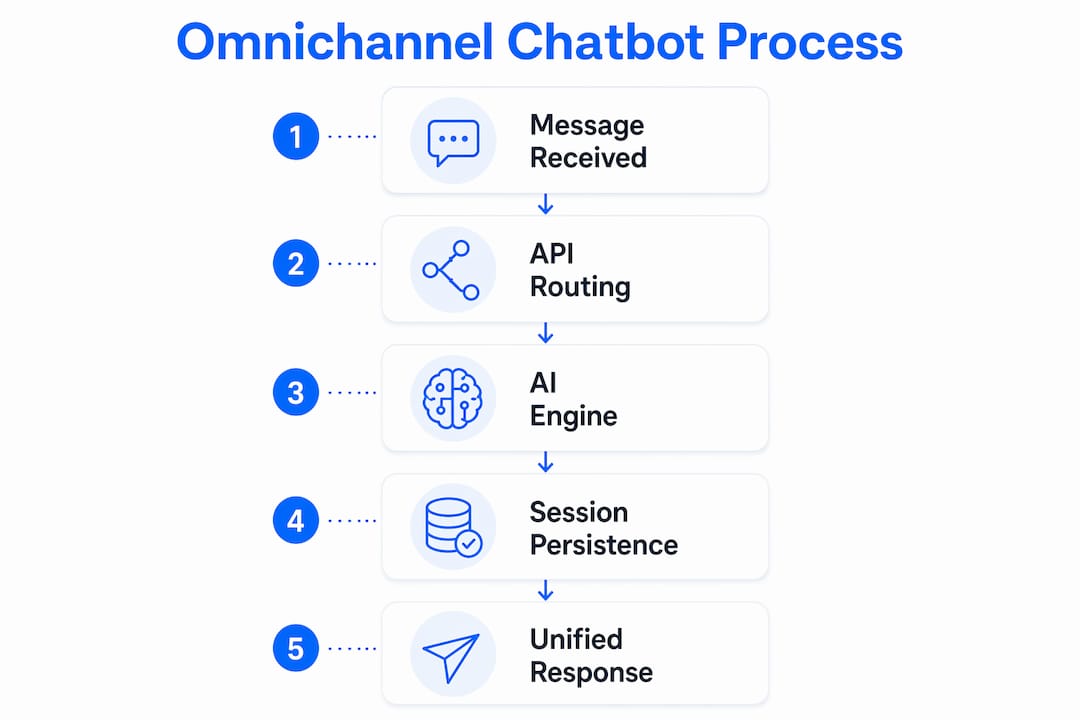
The architecture behind a cross-channel chatbot is built on three layers working together: the front-end channel interfaces, a central AI engine, and a unified data layer.
When a customer sends a message on any channel, that message routes through an API integration to the central AI engine. The engine checks the unified customer record, processes the query using a trained language model, and returns a response through the same channel. Every interaction updates the shared data layer, so the next message, whether it arrives on a different platform an hour later or a week later, picks up exactly where things left off.

Session persistence is the technical mechanism that makes this work. Rather than treating each channel as a fresh session, the platform assigns a persistent customer identifier that follows the conversation across touchpoints. Technologies like cloud-based API gateways, webhook integrations, and large language models (LLMs) handle the real-time routing and response generation.
When the chatbot reaches the limits of what it can resolve, escalation kicks in. The handoff to a human agent carries the full conversation context, including intent signals, sentiment data, and relevant customer metadata like order history. Agents do not start from scratch. They pick up mid-conversation with everything they need already on screen.
Key components enabling this flow:
- API integrations connecting each front-end channel to the backend engine
- Cloud infrastructure for real-time data sync and uptime across platforms
- AI and NLP models for intent recognition and response generation
- Unified customer profiles storing interaction history, preferences, and metadata
- Escalation logic that triggers human handoff with context intact
What types of chatbots exist, and where does the omnichannel version fit?
Not all chatbots are built the same, and understanding the spectrum helps clarify why omnichannel implementations are a different category entirely.
Menu/button-based chatbots present users with predefined options. They work for narrow, predictable tasks like checking store hours, but they break down the moment a customer asks something outside the script.
Rule-based chatbots use if/then logic to handle slightly more complex queries. They are faster to build than AI-powered bots but require constant manual updates as business conditions change.
AI-powered chatbots use natural language processing (NLP) to understand intent rather than matching keywords. They handle open-ended questions, learn from interactions, and generate contextually relevant answers. Most modern deployments fall here.
Voice chatbots operate through spoken language, typically over phone systems or smart speakers. They use speech-to-text and text-to-speech processing alongside NLP.
Generative AI chatbots represent the current frontier, using large language models to produce fluid, human-like responses from a broad knowledge base. They can handle nuanced conversations that earlier rule-based systems could not touch.
An omnichannel chatbot is not a separate type in the same sense. It is an AI-powered or generative AI chatbot deployed with a multi-platform integration layer on top. The distinction is architectural: the bot does not just understand language, it operates across every channel your customers use while maintaining a single, continuous view of each customer. Single-channel bots, regardless of how sophisticated their AI is, cannot do that.
Key features and benefits that make omnichannel chatbots worth the investment
The business case for an omnichannel messaging platform comes down to three things: faster responses, consistent quality, and agents who spend time on problems that actually need them.
A centralized management dashboard gives support teams visibility across every channel from one screen. Agents see the full conversation history, regardless of where it started, and can respond without switching between five different tools. That alone reduces the cognitive load that fragments support quality.
AI-driven routing and response suggestions cut handling time further. The system analyzes incoming messages, classifies intent, and either resolves the query automatically or routes it to the right team with a suggested response pre-loaded. Sentiment detection flags frustrated customers for priority handling before they escalate on their own.
Chatbot deflection handles FAQs and routine inquiries without agent involvement, which frees your team for complex issues that genuinely require human judgment. The result is a measurable improvement in first-contact resolution rates and average response time.
| Metric | Impact of omnichannel chatbot adoption |
|---|---|
| Average response time | Reduced through automated FAQ handling and instant routing |
| First-contact resolution | Improved by context-aware responses and smart escalation |
| Agent workload | Decreased as routine queries are deflected to the chatbot |
| Customer satisfaction score | Higher due to consistent, personalized cross-channel experience |
| Lead conversion rate | Increased through 24/7 availability and proactive engagement |
Integration with CRM platforms, e-commerce systems, and scheduling tools extends the chatbot’s usefulness beyond support. It can pull order data, update customer records, and trigger workflows automatically, turning a reactive support tool into an active part of the customer engagement operation.
Real-world use cases where omnichannel chatbots drive results
The industries seeing the clearest returns from chatbot-driven customer engagement tend to share one trait: high inquiry volume with a significant portion of repetitive, answerable questions.
E-commerce is the most obvious fit. A customer who abandons a cart can receive a WhatsApp message with a personalized follow-up. If they reply with a question about sizing, the bot answers. If they need to change a delivery address, the bot handles it. If they want a refund, the bot collects the details and routes to a human with the order history already loaded.

Real estate teams use omnichannel bots to qualify leads around the clock. A prospect who fills out a form at 11 PM gets an immediate response, answers a few qualifying questions, and books a showing, all without a human agent involved. The agent arrives the next morning with a pre-qualified lead and a scheduled appointment.
Hospitality properties deploy chatbots across booking platforms, SMS, and email to handle reservation changes, room requests, and local recommendations. Guests who message on one platform and follow up on another get a consistent experience without the front desk needing to track down conversation history.
SaaS support teams use omnichannel bots to handle tier-one troubleshooting, documentation lookups, and account queries. The bot resolves what it can, escalates what it cannot, and passes the full conversation context to a support engineer who can pick up mid-thread.
Common scenarios across all four:
- Lead qualification and routing to sales
- Appointment and booking scheduling
- FAQ handling and self-service resolution
- 24/7 support coverage without additional headcount
- Proactive outreach triggered by customer behavior
How to deploy an omnichannel chatbot without creating new problems
Deployment done poorly creates exactly the fragmentation it was meant to fix. A phased approach avoids that.
- Audit your current channels. Identify where customers actually contact you most, not where you wish they did. Start with the top two or three.
- Define the chatbot’s scope. Decide which query types it will handle autonomously and which it will escalate. Scope creep at launch is a common failure point.
- Train the AI on your business context. Feed it your product catalog, FAQs, policies, and past support tickets. Generic out-of-the-box models underperform without this.
- Integrate with your CRM and backend systems. The chatbot needs access to customer records, order data, and scheduling tools to give accurate, personalized responses.
- Build escalation workflows. Define the triggers for human handoff and confirm that context, including intent, sentiment, and relevant history, transfers with the conversation.
- Launch on primary channels first. Omnichannel integration complexity is real. Starting narrow lets you fine-tune AI accuracy and operational stability before expanding.
- Monitor and retrain continuously. Track where the bot fails, what it misunderstands, and what customers ask that it cannot answer. Use that data to improve the model regularly.
Expert insights on the challenges you will actually face
The most common failure mode in omnichannel chatbot deployments is not technical. It is organizational. Teams launch on too many channels at once, the backend cannot keep up, and customers end up with a worse experience than before.
Digital noise is the term for what happens when a business adds channels without the integration to support them. More touchpoints without coordination means longer response times, inconsistent answers, and customers who have to repeat themselves. Adding a channel should only happen when the backend can handle it properly.
Context handoff between the chatbot and human agents deserves more attention than most implementations give it. Passing a raw chat transcript is not enough. Effective handoffs transfer intent, sentiment, and metadata like purchase history, so the agent can resolve the issue without re-interviewing the customer.
**Pro Tip:** Before expanding to a new channel, run a 30-day performance review on your existing channels. If resolution rates or satisfaction scores are below target, fix those first. A new channel will not solve an underlying integration problem.
Key best practices for maintaining consistent quality:
- Design for the customer journey, not the channel list
- Standardize response tone and escalation criteria across all platforms
- Audit context transfer quality regularly, not just resolution rates
- Keep human agents informed about chatbot capabilities so they set realistic expectations
- Review AI model performance per channel, since language patterns differ between SMS and email
Metrics and KPIs to measure omnichannel chatbot effectiveness
Measuring a cross-channel chatbot requires looking beyond simple resolution rates. The right KPIs reflect both the bot’s performance and its effect on the broader support operation.
Containment rate measures the percentage of conversations the chatbot resolves without human escalation. A higher rate means the bot is handling its intended scope effectively.
First-contact resolution (FCR) tracks whether a customer’s issue is resolved in a single interaction, regardless of channel. Omnichannel systems tend to improve FCR because context does not get lost between touchpoints.
Average handle time (AHT) covers the total time from first message to resolution. Chatbot deflection of routine queries pulls this number down for the overall support operation.
Customer satisfaction score (CSAT) and Net Promoter Score (NPS) capture the customer’s perception of the experience. Integrated chatbot platforms consistently show positive movement in both when deployed with proper context retention.
Channel switch rate is specific to omnichannel deployments. It measures how often customers move between channels during a single issue. A high rate with low satisfaction suggests the bot is not resolving queries before customers seek another route.
Escalation rate and escalation quality matter together. A low escalation rate is only good if the escalated conversations are genuinely complex. If simple queries are escalating, the AI needs retraining.
How omnichannel chatbots compare to single-channel chatbots
The gap between a single-channel chatbot and a true omnichannel deployment is wider than most decision makers expect before they have run both.
| Dimension | Single-channel chatbot | Omnichannel chatbot |
|---|---|---|
| Channel coverage | One platform only | All active customer channels |
| Customer data | Siloed per session | Unified customer record across channels |
| Context continuity | Resets each session | Persists across channels and time |
| Escalation quality | Transcript only | Full context with metadata |
| Integration complexity | Low | Higher, requires backend coordination |
| Customer experience | Inconsistent across channels | Consistent regardless of channel |
| Deployment speed | Fast | Phased, requires planning |
A single-channel bot is faster to deploy and cheaper to maintain. For businesses with a genuinely narrow support footprint, that trade-off makes sense. But for any business where customers contact you through more than one channel, and most do, the single-channel approach forces customers to repeat themselves every time they switch. That friction compounds over time into churn.
The omnichannel approach treats the customer as a continuous relationship, not a series of isolated transactions. That shift in framing changes what the technology is actually optimizing for.
What the future of omnichannel chatbot technology looks like in 2026 and beyond
Several trends are reshaping what omnichannel chatbots can do, and the pace of change is accelerating.
**Generative AI integration** is moving from experimental to standard. Chatbots built on large language models like those powering Azure Communication Services can retrieve and summarize information from internal knowledge bases in natural language, handling queries that would have required a human agent two years ago.
Proactive engagement is shifting chatbots from reactive tools to outbound ones. Rather than waiting for a customer to initiate contact, AI agents trigger conversations based on behavioral signals, a cart abandoned, a subscription about to lapse, a support ticket left unresolved.
Voice and text convergence is closing the gap between phone-based and text-based support. Customers increasingly expect the same context continuity whether they are typing or speaking, and platforms are building toward that unified experience.
Hyper-personalization is becoming a baseline expectation. Chatbots that pull real-time data from CRM, purchase history, and behavioral analytics can tailor responses at a level that feels genuinely individual rather than templated.
Tighter human-AI collaboration is the operational direction most enterprise deployments are heading. Rather than replacing agents, AI handles volume and routes intelligently, while humans focus on the complex, high-value interactions where judgment and empathy matter most.
Chirps gives you a ready-built omnichannel AI agent, not a DIY project
Most businesses that evaluate omnichannel chatbot platforms face the same problem: the tools that offer deep customization require months of engineering work, and the tools that deploy quickly do not integrate deeply enough to be useful.
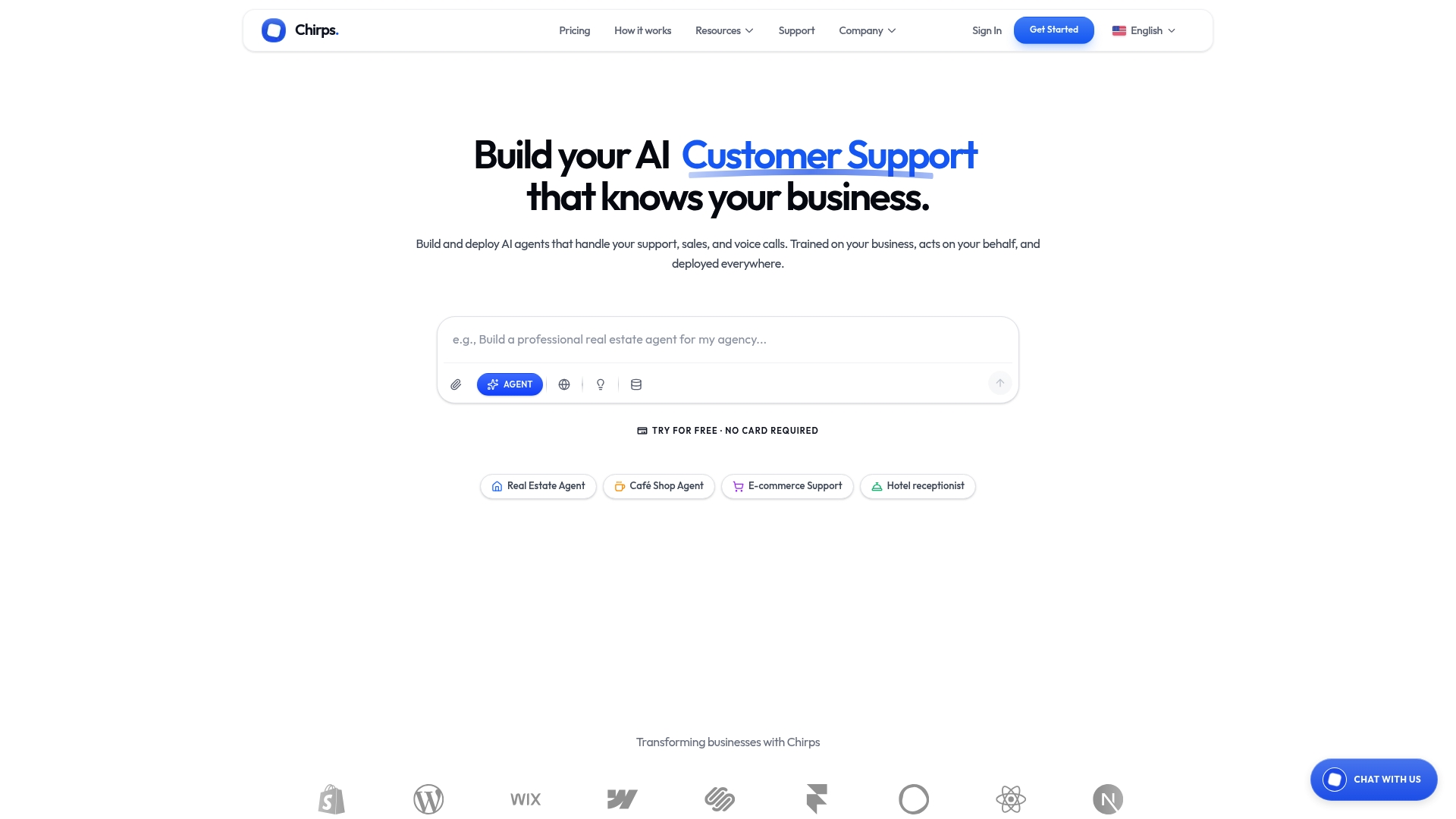
Chirps is built for businesses that need both. The platform deploys AI agents trained on your specific operations, connecting website chat, WhatsApp, SMS, email, Discord, and voice calls into a single system with real-time updates and a unified reporting dashboard. You get lead qualification, appointment scheduling, inbound and outbound voice, and 24/7 support coverage without building the infrastructure from scratch. Real estate teams, e-commerce operators, and hospitality businesses use Chirps to handle customer inquiries instantly and accurately, reducing wait times while keeping human agents focused on the conversations that actually need them. If you are ready to deploy an AI agent that works across every channel your customers use, start with Chirps today.
Key Takeaways
An omnichannel chatbot delivers consistent, context-aware customer interactions across every channel by maintaining a single unified customer record and transferring full conversation context at every handoff.
| Point | Details |
|---|---|
| Unified customer record | Omnichannel systems consolidate all channel data into one profile, eliminating repeated explanations. |
| Phased deployment wins | Launching on your top two or three channels first improves AI accuracy before you scale. |
| Context handoff quality | Effective escalation transfers intent, sentiment, and metadata, not just a raw chat transcript. |
| KPIs that matter | Containment rate, first-contact resolution, and channel switch rate measure real omnichannel performance. |
| Chirps for deployment | Chirps provides a ready-built AI agent platform connecting voice, chat, and messaging channels with real-time updates and business-specific training. |