

Local presence dialing is the practice of placing outbound calls from phone numbers that match the recipient’s local area code. When your AI-powered sales or support assistant dials a prospect in Austin using a 512 number instead of a toll-free 800 line, that prospect is far more likely to pick up. Studies show answer rates lift significantly depending on sector and call type, with SMB outreach seeing the steepest gains.
The technique works because people instinctively trust familiar-looking numbers. An unknown 800 number reads telemarketer. A local area code reads someone nearby. That psychological gap is what local presence dialing exploits, legally and deliberately.
Legal is the operative word. Local presence dialing is not spoofing. Spoofing means transmitting false caller ID with intent to deceive, which violates the Truth in Caller ID Act and FCC rules with fines up to $10,000 per call. Local presence dialing uses real, owned phone numbers registered with carriers and attested under the STIR/SHAKEN framework. The number on the recipient’s screen is a real number your platform controls and can receive callbacks on. That distinction matters legally and operationally.
- Calls display a local area code matching the recipient’s geography
- Numbers are legitimately owned, registered, and STIR/SHAKEN-attested
- Callbacks reach a real agent, AI assistant, or voicemail with proper identification
- The practice aligns with AI outreach by improving first-contact success rates across automated voice campaigns
Why local presence dialing pays off for AI-powered businesses
The lift in answer rates is the headline benefit, but the downstream effects on AI-driven sales and support pipelines are just as significant.
Answer rate improvements are real and measurable. SMB outbound calls typically see a 35–45% lift from local presence dialing, mid-market campaigns 25–30%, and enterprise outreach 15–20%. Rural prospects respond even more strongly (30–50% lift) than metro areas (15–25%) because familiarity with local numbers runs deeper in smaller communities.
Stat to know: Local numbers outperform toll-free lines by a significant margin on outbound calls, a gap that compounds fast when your AI assistant is dialing hundreds of contacts per day.
That said, the lift is not unlimited. Buyer skepticism has grown year-over-year, and the advantage has narrowed recently as spam filters improve. The technique still works, but it works best when paired with strong number reputation, good timing, and proper callback handling.
- Higher answer rates mean more conversations per campaign, directly improving lead qualification throughput for AI sales assistants
- Local caller ID builds initial trust, making recipients more receptive before the AI agent even speaks
- Callbacks routed to live agents or AI assistants convert missed calls into second-chance engagements
- Mobile outreach benefits most; business landline calls show minimal improvement, so targeting mobile contacts maximizes ROI
What keeps local presence dialing legal in the United States
The line between local presence dialing and illegal spoofing comes down to three things: ownership, intent, and callback capability.
Under the Truth in Caller ID Act, transmitting misleading or inaccurate caller ID information with intent to defraud, cause harm, or wrongfully obtain anything of value is prohibited. Displaying a local number you legitimately own is not a violation. The FCC has confirmed that displaying a local number is not inherently unlawful; the violation occurs when that display is part of a scheme to deceive.
STIR/SHAKEN is the technical backbone of compliance. The STIR/SHAKEN framework authenticates caller ID information so carriers can verify the originating provider had the right to use that number. Level A attestation means the provider has verified rights to the number and the call originated from an identified customer. Lower attestation grades increase the probability of spam flagging, which defeats the entire purpose of local presence dialing.
- Own or lease every number you display; never use numbers you do not control
- Maintain STIR/SHAKEN Level A attestation to keep carrier trust high
- Every local number must be capable of receiving inbound callbacks
- Comply with TCPA restrictions: respect calling hours (8 AM–9 PM local time), honor do-not-call lists, and disclose the caller’s identity
- Identify your business when a callback is answered; anonymous callbacks erode trust and invite complaints
Best practices that actually move the needle
Getting the area code right is just the starting point. Number reputation and call timing drive results as much as the geographic match itself.

Cap call volume per number. High call volume per number triggers carrier spam detection. A practical ceiling that keeps reputation intact is recommended, with rotation across a pool of numbers within the same area code rather than hammering a single line.
Match area codes to actual prospect density. Align your number pool to where your contacts actually live. Rural zones need more granular coverage because a number from the wrong county can still feel “off” to a local. Metro areas are more forgiving, but competition for attention is higher.
Schedule calls by local time zone. An AI assistant dialing California contacts at 7 AM Pacific while the system clock is set to Eastern time is a fast way to generate complaints. Build time-zone-aware scheduling into your campaign logic.
Monitor number health continuously. Flagged numbers need to be retired and replaced quickly. A number that carriers have labeled “Spam Likely” will hurt answer rates worse than a toll-free number.
Route callbacks properly. When a prospect calls back a local number your AI used, they need to reach something useful: a live agent, a queue, or a voicemail with a clear business name. Dead ends or generic voicemail boxes signal spoofing to both carriers and recipients.
How Chirps brings local presence dialing into AI-powered outreach
Chirps is built for exactly this use case. The platform provides businesses with a deep pool of real, leased phone numbers spanning hundreds of US area codes, each carrying STIR/SHAKEN Level A attestation. That means every outbound call your AI assistant places goes out with a verified, carrier-trusted local number, not a recycled line with a damaged reputation.
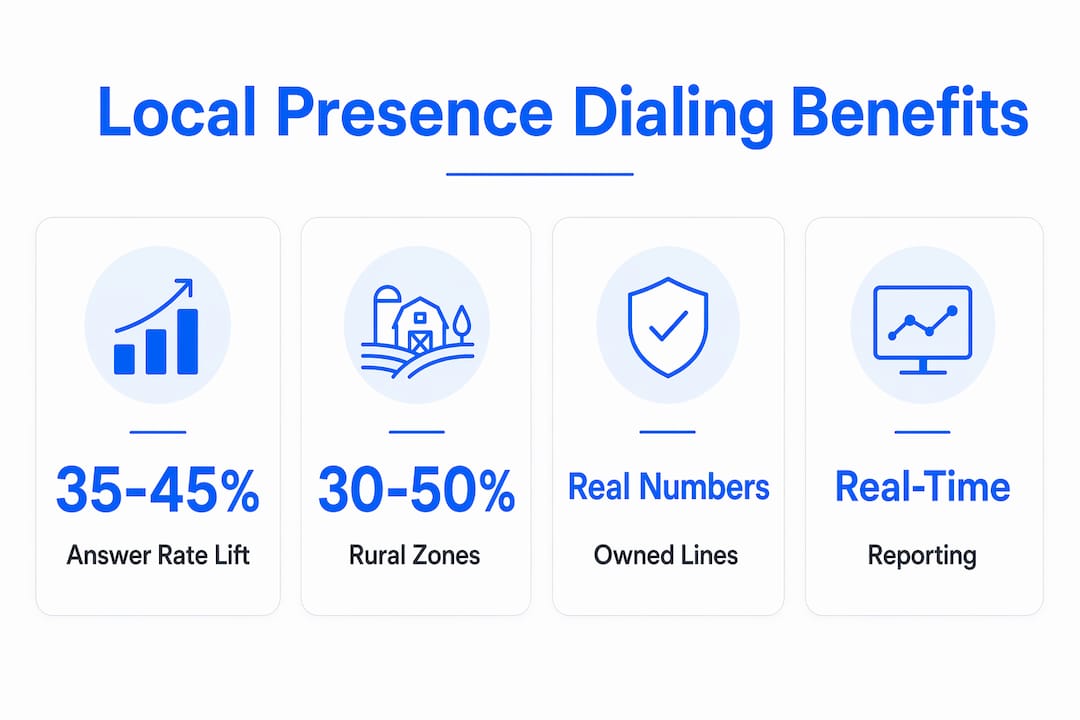
Intelligent number rotation is built into the platform. Chirps monitors carrier-specific reputation signals in real time and automatically cycles numbers before they approach volume thresholds that trigger spam flags. You do not need to manage this manually.
Callback routing is configured at the platform level. When a prospect calls back a Chirps-assigned local number, the system routes them to the right AI assistant or human agent based on the original campaign context. A real estate lead calling back gets a real estate-trained AI; a support inquiry routes to the appropriate queue. That context-aware routing is what separates a professional local presence setup from a basic area code swap.
| Capability | What Chirps delivers |
|---|---|
| Number pool | Hundreds of US area codes with real, owned numbers |
| STIR/SHAKEN | Level A attestation on all outbound numbers |
| Number rotation | Carrier-intelligent, automated rotation to protect reputation |
| Callback routing | Context-aware routing to AI assistants or live agents |
| Monitoring | Real-time spam flag detection and number replacement |
| Reporting | Campaign-level analytics on answer rates and engagement |
Real-time reporting gives operations teams visibility into which area codes are performing, which numbers are approaching risk thresholds, and where answer rates are trending. That data feeds directly back into campaign optimization.
What local presence dialing looks like in practice
A real estate firm running AI-powered lead follow-up across three states saw a consistent pattern: prospects in smaller markets who received calls from matching local area codes answered at significantly higher rates than those receiving calls from the firm’s main office number. The AI assistant handled initial qualification, and callbacks from interested prospects were routed to human agents with full conversation context already captured.
An e-commerce brand using AI for post-purchase support outreach found that local area code calling reduced the number of calls that went straight to voicemail, giving the AI assistant more live conversations per campaign. The improvement was most pronounced in rural zip codes, consistent with the higher rural lift data that geographic call routing research consistently shows.
Both scenarios share the same underlying dynamic: the local number gets the call answered, and the AI platform handles everything after that. The two capabilities reinforce each other.
Chirps gives your AI voice outreach a local edge
Your AI assistant can be perfectly trained, perfectly scripted, and perfectly timed. None of that matters if the call never gets answered. Chirps solves the first problem in the chain by pairing your AI voice and multi-channel campaigns with real local numbers, carrier-verified attestation, and intelligent rotation that keeps those numbers clean.
For businesses in real estate, e-commerce, hospitality, or any sector where outbound voice is part of the customer journey, Chirps handles the full stack: AI-powered outreach with local presence built in, callback routing that preserves context, and reporting that shows you exactly what is working. No separate telephony vendor, no manual number management, no compliance guesswork.
Start with a free trial at chirps.cc and see what your answer rates look like when every call goes out with a number your prospects actually trust.
Key Takeaways
Local presence dialing lifts answer rates 20–40% by matching outbound call numbers to recipient area codes, with SMB outbound calls typically seeing a 35–45% lift, mid-market 25–30%, and enterprise 15–20%. Rural zones experience higher lifts of 30–50% compared to 15–25% in metropolitan areas, but only deliver consistent ROI when paired with STIR/SHAKEN compliance, intelligent number rotation, and proper callback routing.
| Point | Details |
|---|---|
| Answer rate lift | SMB outbound calls typically see a 35–45% lift; rural zones 30–50%, metro areas 15–25%. |
| Legal compliance | Numbers must be owned, STIR/SHAKEN Level A attested, and capable of receiving callbacks. |
| Volume caps matter | High call volume per number triggers carrier spam detection; rotate numbers to stay clean. |
| Mobile over landline | Mobile outreach benefits most; business landline calls show minimal improvement. |
| Chirps platform | Chirps provides hundreds of US area codes with automated rotation, Level A attestation, and context-aware callback routing for AI-powered campaigns. |