

What is call center automation, and what does it actually include?
Call center automation applies AI and automation technology to handle routine customer service tasks without requiring a live agent for every interaction. The core idea is straightforward: let software manage the predictable, repetitive work so your agents can focus on conversations that genuinely need a human. Gartner Peer Insights describes this as using AI-powered technology to automate routine customer service processes and repetitive tasks to improve efficiency.
The main components you’ll encounter include:
- Interactive Voice Response (IVR): Automated phone menus that collect caller input and route calls without a live operator
- AI chatbots: Text-based agents that handle FAQs, scheduling, and simple transactions around the clock
- Automatic Call Distribution (ACD): Systems that route inbound calls to the right agent or queue based on defined rules
- Workflow automation: Backend tools that trigger actions, send notifications, and update records without manual input
- AI agents: Custom-trained virtual assistants that handle voice and chat interactions end to end
- Real-time analytics: Dashboards that surface performance data and flag issues as they happen
Together, these components form a layered system. A caller might speak to an IVR, get routed by ACD, and only reach a human agent when the issue genuinely requires one.
Table of Contents
- Why the benefits of call center automation go beyond cost savings
- How AI-driven automation technologies operate inside a call center
- Common use cases that show call center automation in action
- What software features actually matter when evaluating automation platforms
- Challenges you’ll face when implementing call center automation
- Best practices that separate successful automation rollouts from expensive failures
- Trends shaping call center automation in 2026
- Why data integration determines whether your automation actually works
- How automation changes what your agents actually do
- How automation affects customer experience, and how to manage it well
- Chirps gives your business a faster path to AI-driven customer support
- Key Takeaways
Why the benefits of call center automation go beyond cost savings
The most obvious win is speed. Automation reduces average handle time, which means faster resolutions and higher customer satisfaction scores. But the operational benefits run deeper than that.
Key advantages include:
- Reduced handle time: Automated triage and self-service cut the time agents spend on routine calls
- 24/7 availability: Chatbots provide instant responses at 3 AM just as reliably as at 3 PM, without overtime costs
- Higher agent productivity: When bots absorb repetitive inquiries, agents handle fewer low-value contacts and spend more time on complex cases
- Lower staffing costs: Automation handles volume spikes without requiring proportional headcount increases
- Better compliance: Automated systems log interactions consistently, reducing the risk of documentation gaps
- Personalization at scale: When automation connects to your CRM, it can surface customer history before a human agent even picks up
The productivity gain for agents is worth emphasizing. Offloading password resets, order status checks, and appointment confirmations to automation frees agents for escalations, retention conversations, and upsell opportunities. Those are the interactions that actually move revenue.
How AI-driven automation technologies operate inside a call center
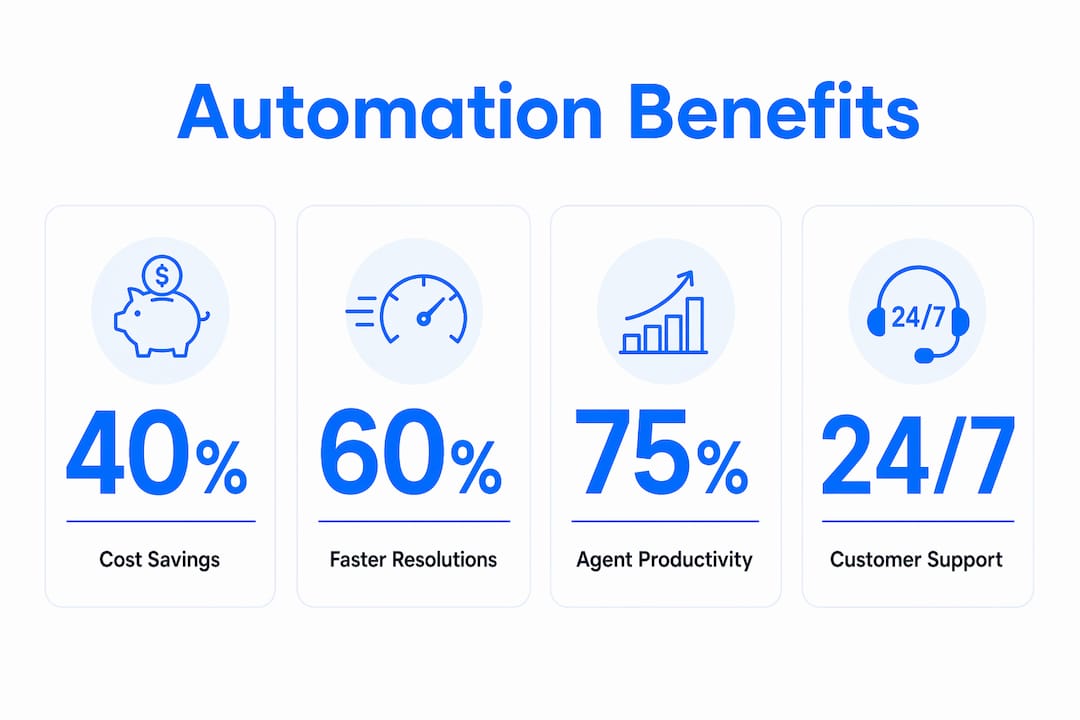
The engine behind modern call center automation is a combination of natural language processing (NLP), machine learning, and real-time data integration. NLP lets systems understand what a customer is saying or typing, even when phrasing varies. Machine learning improves accuracy over time by learning from past interactions.
Here’s how a typical automated interaction flows:
- A customer calls or messages
- The IVR or chatbot captures intent through spoken or typed input
- ACD or routing logic directs the interaction based on skill, priority, or time of day
- The AI agent pulls relevant customer data from the CRM to personalize the response
- If the issue exceeds the bot’s capability, it hands off to a live agent with full context preserved
- Post-interaction, analytics tools log outcomes and flag patterns for review
Analytics and real-time reporting tools are what turn raw interaction data into workflow improvements. Without them, you’re operating blind.
| Technology | Primary Function | Key Benefit |
|---|---|---|
| IVR | Collects caller input, routes calls | Eliminates live operators for routine routing |
| ACD | Distributes inbound calls to agents | Reduces wait times, improves queue management |
| AI chatbot | Handles text-based inquiries | 24/7 coverage without agent involvement |
| NLP engine | Interprets customer language | Enables conversational, not menu-driven, interactions |
| CRM integration | Surfaces customer history | Personalizes every interaction automatically |
| Real-time analytics | Monitors performance live | Identifies bottlenecks before they escalate |
| Workflow automation | Triggers backend actions | Reduces manual data entry and follow-up tasks |

Common use cases that show call center automation in action
Knowing the technology is one thing. Seeing where it actually gets deployed helps you identify which processes in your own center are ready for automation first.
- Self-service via IVR and chatbots: Customers check order status, reset passwords, or get account balances without ever reaching an agent. IVR systems route calls to the right destination based on spoken or touch-tone input, cutting queue times significantly.
- Skill-based routing: Routing customers to agents with specific expertise improves first-call resolution rates. A billing question goes to billing; a technical issue goes to tier-two support.
- Appointment scheduling: AI agents handle booking, rescheduling, and reminders without agent involvement, a high-volume task in healthcare, hospitality, and professional services.
- Lead qualification: Outbound AI voice agents ask qualifying questions, score leads, and pass warm prospects to sales reps, compressing the top of the funnel.
- Automated outbound notifications: Payment reminders, shipping updates, and appointment confirmations go out automatically, reducing inbound call volume from customers chasing status updates.
- Agent assist tools: Real-time AI surfaces suggested responses, relevant knowledge base articles, and compliance prompts during live calls, cutting handle time and reducing errors.
The lead qualification use case often surprises operations managers. An AI voice agent can work a list of hundreds of prospects overnight, and hand only the qualified ones to a human rep the next morning.
What software features actually matter when evaluating automation platforms
Not every platform delivers equally on every feature. When you’re evaluating call center technology solutions, these are the capabilities that separate functional systems from ones that create new problems.
- Omnichannel support: Managing voice, chat, email, and social from a single platform prevents agents from toggling between disconnected tools and gives customers a consistent experience regardless of channel
- CRM and data platform integration: Without this, automation can’t personalize interactions or pass context to agents on handoff
- Conversational IVR: Modern IVR should handle natural speech, not just touch-tone menus. Rigid legacy menus frustrate customers and inflate abandonment rates.
- Skill-based and priority routing: ACD logic that matches callers to the right agent type, not just the next available one
- Analytics dashboards: Real-time and historical reporting that shows handle time, resolution rates, queue depth, and bot containment rates
- Workflow automation: Tools that trigger follow-up emails, update CRM records, or escalate tickets automatically after an interaction closes
- Agent assist: AI that surfaces relevant information during a live call, not after it
- Security and compliance features: Call recording controls, data masking, access permissions, and audit logs that satisfy HIPAA, PCI-DSS, or CCPA requirements depending on your industry
Pro Tip: Before signing any contract, ask vendors specifically how their platform handles a failed bot handoff. The answer tells you more about real-world reliability than any feature checklist.
Challenges you’ll face when implementing call center automation
Automation implementations fail more often from organizational and integration problems than from technology limitations. Going in with clear eyes about the obstacles saves time and budget.
- Integration complexity: Connecting automation tools to legacy CRMs, ticketing systems, and data warehouses is rarely plug-and-play. Disconnected systems produce poor customer experiences and unmet expectations for personalization.
- Workforce resistance: Adoption challenges often stem from workforce resistance, particularly when agents fear job displacement rather than role evolution. Change management is not optional.
- Customer experience risk: Poorly designed bots that can’t escalate gracefully, or IVR trees that trap callers in loops, actively damage satisfaction scores. Automation done badly is worse than no automation.
- Data quality: AI systems are only as good as the data they’re trained on. Outdated CRM records, inconsistent tagging, and siloed databases all degrade bot performance.
- Compliance and privacy: US-based operations must account for CCPA, HIPAA (for healthcare), and PCI-DSS (for payment handling). Automated systems that record calls or store customer data need explicit governance policies.
- ROI measurement: Attributing cost savings and satisfaction improvements specifically to automation, rather than to other concurrent changes, requires baseline metrics established before go-live.
The compliance point deserves more attention than most vendors give it. Automated call recording, AI-generated transcripts, and customer data stored in cloud platforms all create obligations under state and federal law. Build your compliance review into the procurement process, not as an afterthought after deployment.
Best practices that separate successful automation rollouts from expensive failures
The difference between a call center automation project that delivers and one that gets quietly shelved usually comes down to how it was planned, not which platform was chosen.
- Define measurable KPIs before you start: Average handle time, bot containment rate, first-call resolution, and customer satisfaction score should all have baseline values before go-live so you can measure actual impact
- Involve agents early: Agents who help design automation workflows are far more likely to use and champion the tools. Their knowledge of edge cases also produces better bot logic.
- Prioritize CRM integration from day one: Automation that can’t access customer history delivers generic interactions. Full integration with CRMs and knowledge platforms is what makes personalized, instant resolution possible.
- Start with high-volume, low-complexity tasks: Password resets, order status, and appointment scheduling are ideal first targets. They’re frequent, predictable, and low-risk if the bot makes a mistake.
- Build in human fallback at every step: Every automated flow needs a clear, graceful path to a live agent. Customers who can’t escape a bot loop don’t call back.
- Monitor and retrain continuously: Bot performance degrades as language patterns, products, and policies change. Schedule regular reviews of containment rates and failure logs.
- Upskill agents for higher-value work: As automation absorbs routine volume, agents need training for complex problem-solving, empathy-driven conversations, and cross-sell situations.
Trends shaping call center automation in 2026
The direction of travel is clear: automation is getting more conversational, more predictive, and more tightly woven into the full customer journey.
- Conversational AI replacing legacy IVR: Voice bots that understand natural speech are displacing touch-tone menus. Customers can state their issue in plain language rather than navigating a numbered tree. The future of automation points toward natural language AI and omnichannel unified journeys.
- Unified omnichannel journeys: Customers expect to start a conversation on chat and continue it by phone without repeating themselves. Platforms that unify these channels into a single interaction record are becoming the baseline expectation.
- Predictive analytics and sentiment analysis: AI that detects customer frustration in real time and alerts supervisors, or predicts which customers are likely to churn, is moving from enterprise-only to broadly available.
- Robotic Process Automation (RPA) for backend workflows: RPA handles the post-call work: updating records, triggering refunds, sending follow-up emails. It’s invisible to customers but cuts agent after-call work time.
- Remote and hybrid workforce integration: Automation tools increasingly support distributed agent teams, with cloud-based platforms that work identically whether an agent is in an office or at home.
- AI transparency and governance: Regulators and customers alike are pushing for clearer disclosure when AI is handling an interaction. Expect more explicit labeling requirements and audit trail demands.
Why data integration determines whether your automation actually works
Automation without data integration is just a more expensive phone tree. The real value comes when your AI agents can access customer history, account status, and past interactions in real time.
- CRM connectivity is the foundation: An AI agent that knows a caller’s last three orders, current subscription tier, and open support ticket can resolve issues in one interaction. Without CRM access, it’s guessing.
- Knowledge base integration: Bots need current product information, policy details, and troubleshooting guides to give accurate answers. Stale or siloed knowledge bases produce wrong answers at scale.
- Customer data platforms (CDPs): CDPs unify behavioral data from web, app, and support channels, giving automation tools a complete picture of the customer rather than a narrow slice.
- Context preservation on handoff: When a bot escalates to a human agent, the agent needs the full conversation history, not a blank screen. Systems that drop context on handoff undo the efficiency gains automation created.
- Disconnected systems are a direct CX liability: Poor integration commonly results in disconnected customer experiences and unmet expectations for personalization and instant resolution.
Key insight: Successful automation relies on deep integration into a company’s existing data ecosystem to deliver personalized and instant customer resolutions. Integration is not a technical detail. It’s the core requirement.
Practical steps to improve data integration include auditing your current data sources before selecting a platform, insisting on native CRM connectors rather than custom API builds, and establishing data governance policies that keep records current. The platforms that deliver the best automation outcomes are almost always the ones with the deepest, most reliable data connections.
How automation changes what your agents actually do
The fear that automation eliminates agent jobs misses what’s actually happening in well-run call centers. Automation shifts the composition of agent work, not just the volume.

Routine, repetitive contacts, the ones agents find least engaging, get absorbed by bots. What remains for human agents is genuinely harder: complex complaints, emotionally charged conversations, high-value retention calls, and situations where judgment matters. That’s a better job description, not a worse one, and it tends to produce lower agent turnover.
The agent role also expands into oversight. Agents increasingly monitor bot conversations, intervene when automation stalls, and flag patterns that need retraining. Workforce planning shifts accordingly: you need fewer agents for routine volume, but the agents you do employ need stronger problem-solving skills and better product knowledge. Training programs that used to focus on call scripts now need to cover escalation judgment, empathy under pressure, and how to use AI assist tools effectively during live calls.
How automation affects customer experience, and how to manage it well
Customers notice automation immediately, and their reaction depends almost entirely on how well it’s designed. A bot that resolves an issue in 90 seconds earns loyalty. A bot that loops a caller through the same menu three times before disconnecting creates a complaint.
The key to positive customer experience with automation is designing for the customer’s goal, not the company’s cost target. That means short, clear IVR prompts rather than exhaustive option lists, bots that acknowledge when they can’t help and escalate without friction, and personalization that makes customers feel recognized rather than processed. Proactive automation, outbound notifications that answer questions before customers need to call, reduces inbound volume while actually improving satisfaction.
Managing the balance between automation and human touch requires ongoing measurement. Track containment rates, but also track post-containment satisfaction scores. A bot that “contains” 70% of contacts but leaves those customers frustrated has not improved your operation. The metric that matters is whether customers got what they needed, not whether a human was involved.
Chirps gives your business a faster path to AI-driven customer support
Most businesses exploring call center automation face the same friction: the technology is mature, but deploying it against your specific products, policies, and customer data takes time and expertise that most teams don’t have in-house.
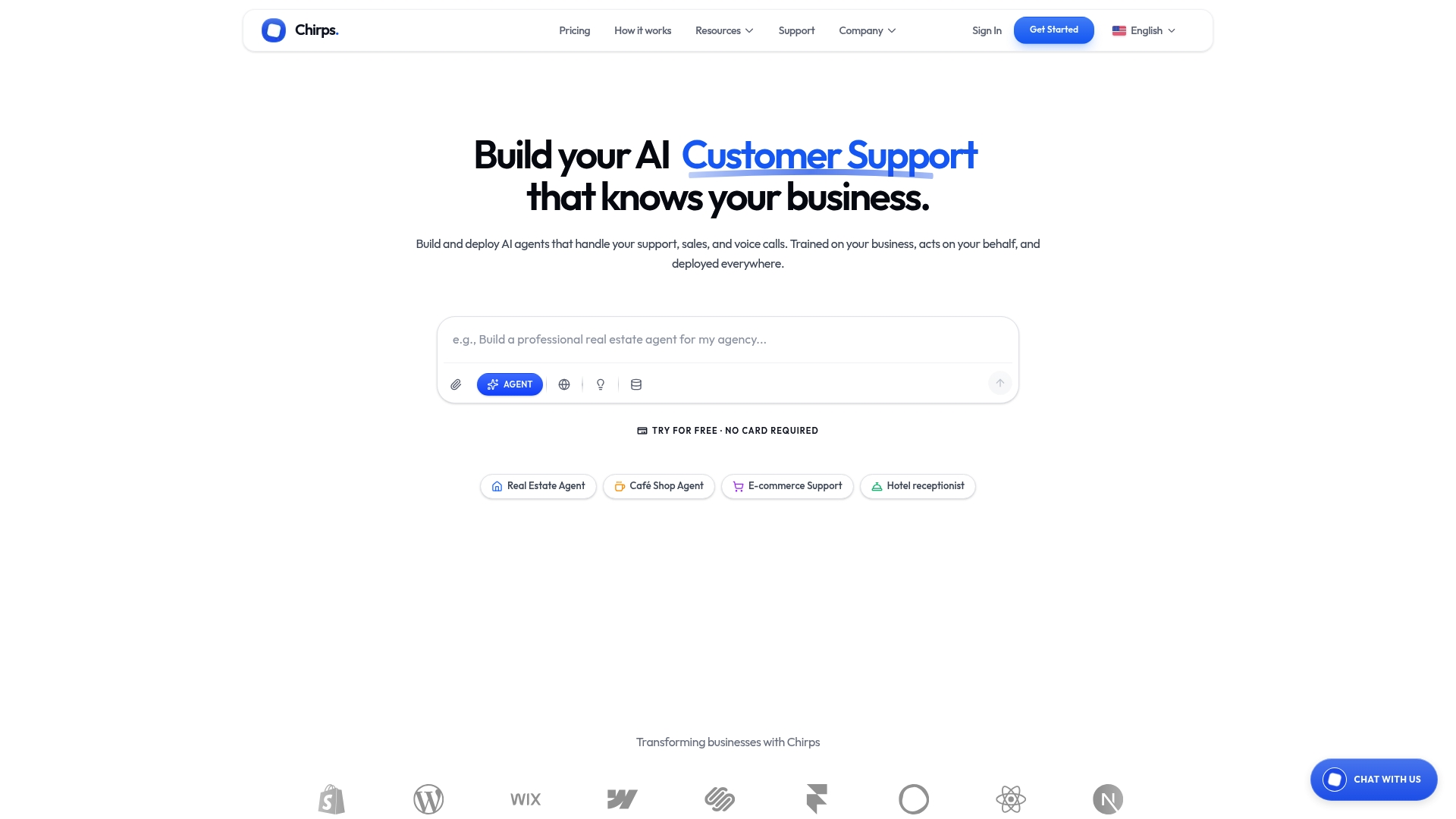
Chirps is built specifically for that gap. The platform lets you deploy custom AI agents trained on your own operations, handling inbound and outbound voice calls, live chat, WhatsApp, SMS, and email from a single system. Agents learn your products, your policies, and your tone, so customer interactions feel on-brand rather than generic. Real-time updates mean your bots stay current as your business changes, without manual retraining cycles. For teams in real estate, e-commerce, hospitality, and professional services, Chirps handles appointment scheduling, lead qualification, and routine support at scale, freeing your human team for the conversations that actually require them. Visit Chirps to see how quickly a custom AI agent can go live for your operation.
Key Takeaways
Call center automation delivers its full value only when AI agents are deeply integrated with your CRM, knowledge base, and customer data, making data connectivity the single most important factor in any implementation.
| Point | Details |
|---|---|
| Automation scope | IVR, chatbots, ACD, and workflow tools together handle routine contacts end to end. |
| Top benefit | Reduced average handle time and 24/7 coverage without proportional staffing increases. |
| Biggest risk | Poor data integration produces disconnected experiences and unmet personalization expectations. |
| Agent impact | Automation shifts agents toward complex, high-value work rather than eliminating their roles. |
| Chirps | Deploys custom AI agents trained on your specific operations across voice, chat, and messaging channels. |